

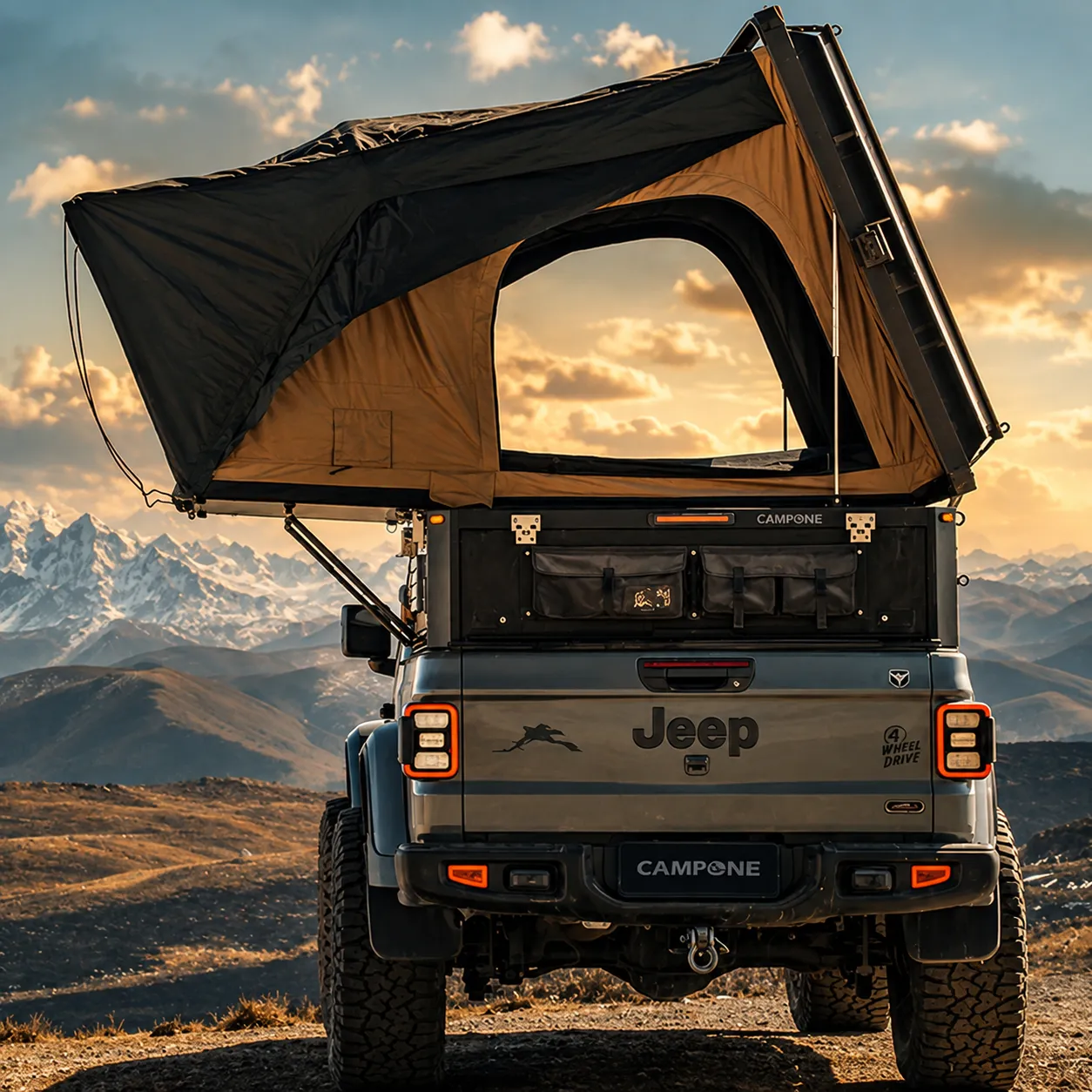
There is no single perfect truck setup for everyone.
Some owners need protected storage. Some want a simple place to sleep on weekend trips. Others want their truck to become a more complete camping space without giving up everyday usability.
The right choice depends on how you actually use your vehicle.
Understanding the difference between a Truck Cap, a traditional Rooftop Tent, and an integrated Pass-Through Camper can help you choose the right level of capability.
Truck Cap: Better Everyday Utility
A Truck Cap is the natural starting point for owners who want to make their truck bed more useful.
It turns an open bed into an enclosed space for tools, luggage, outdoor equipment, and everyday cargo.
For CampOne, this is LEVEL 1 — Vehicle Integration.
The CampOne Truck Cap is factory-prebuilt as one complete unit, combining an all-aluminum structure, side access, weather protection, accessory mounting, and vehicle-specific installation.
It is ideal when your priorities are:
- Secure, enclosed truck-bed storage
- Everyday practicality
- Weather protection
- Easy access to equipment
- Flexible accessory expansion
You keep the fundamental utility of your truck while gaining a more protected and versatile cargo space.
Rooftop Tent: Simple Sleeping Space
A traditional Rooftop Tent adds an elevated sleeping area above your vehicle.
For occasional camping, it can be a simple way to get off the ground without towing a trailer.
But in most conventional setups, the tent and truck bed remain two separate spaces.
You leave the vehicle, climb into the tent from outside, and use the truck bed separately for storage.
For some campers, that is all they need.
For others, especially those spending more time on the road, the separation between storage, living, and sleeping areas becomes more noticeable.
CAP1 Classic: One Continuous Camping Space
This is where CampOne LEVEL 2 — Pass-Through Integration changes the experience.
CAP1 Classic is not simply a Truck Cap with a Rooftop Tent added on top.
The truck cap and rooftop tent are developed around the same pass-through system from the beginning.
Once installed, the truck cap roof also becomes part of the tent floor structure. Open it, and the truck bed connects directly with the upper sleeping area.
You can move from the truck bed into the rooftop tent without stepping outside.
The result is:
Two factory-prebuilt modules. One continuous camping space.
CAP1 Classic is particularly suited to campers who want more interior room and a more connected camping experience while still maintaining everyday vehicle practicality.
UniLift™: Complete Camper Integration
For drivers who want camping capability to become an even more natural part of everyday vehicle use, there is LEVEL 3 — Complete Camper Integration.
UniLift™ takes the CampOne concept further.
The truck cap, integrated lift system, and rooftop sleeping area are engineered and factory-prebuilt as one complete camper.
When closed, the system sits nearly level with the cab roof, helping maintain a clean vehicle profile and making garages, parking structures, and everyday driving easier.
At camp, the integrated roof rises to create a continuous interior connecting the truck bed and sleeping space.
Built as One. Shipped as One. Installed as One.
Which One Is Right for You?
Think about what you expect from your truck.
If protected storage and everyday utility are your priorities, start with the Truck Cap.
If you want a true pass-through camping experience with more interior space, CAP1 Classic brings the truck bed and rooftop sleeping area together.
If you want the highest level of integration, a lower closed profile, and one complete factory-prebuilt camper, UniLift™ is designed to bring everyday driving and camping into the same system.
One Philosophy. Three Levels of Integration.
The three CampOne systems provide different levels of capability, but they share the same philosophy:
Designed as One.
Engineered as One.
Built as One.
Installed as One.
From everyday storage to a complete integrated camper, choose the level that fits the way you use your truck—and the places you want it to take you.